Showing posts with label Birds. Show all posts

Monday, April 14, 2008

Happy "Hatch" Day

We checked on the four Killdeer eggs yesterday, all was well!

And today:


The adult birds incubate the eggs for 24 to 26 days before they are ready to hatch (our took 25 days). A chick takes 18 to 36 hours to break out of the shell, and the parents will removed every piece from the vicinity of the nest within shorty after hatching.

When the young are first hatched, they are completely covered in thick down and resemble their parents, except that they have only one band, not two, across the chest. At first this down is wet, but it dries within an hour or so, and the young birds look like fluffy balls with rather long legs. Unlike the young of songbirds, shorebird young leave the nest as soon as their down has dried, they are able to feed themselves within a day, running about quickly, jabbing at the ground for small insects. The downy plumage is lost rapidly as they grow, and by midsummer they are almost indistinguishable from adults. However, head patterns are less distinct, and all browns are paler.

The adults do not have to feed the young. However, they do watch them constantly and do a thorough job of brooding, guarding against enemies, and warning of danger. At the first sign of danger, the parent will give an alarm note that alerts the chicks to freeze. The young will squat motionless until the parent gives an all-clear signal. Soft calls will bring the chicks running to nestle under the parent's warm feathers for a short nap or for the night. For the first few days, the chicks are brooded often to protect them from the sun or from the cold and wet. The parents cease to brood them at all after about 24 days and after 40 days the young birds are ready to fly.

Thursday, March 20, 2008

Tuesday, March 18, 2008

Sunday, March 16, 2008

Killdeer

Friday afternoon, down by the Fish Pond:


Killdeer exhibit a clever “broken wing display” in which they appear to be struggling with a broken wing while all the while leading the predator away from their babies. Once their young are out of danger they “recover’ and fly off.

They are ground-nesting birds that are famous for hiding their nests right out in the open. They really use no nesting materials and rely on distraction displays to protect their offspring.


Friday Afternoon: Single Egg


Saturday Afternoon: Two Eggs

Wednesday, February 20, 2008

Martins are in the House

The Purple Martins are back - a week earlier than last year! Yay, Spring!!!


Monday, January 21, 2008

Metro Monday


Metro loves to watch the birds. Doesn't matter if it is from the golf cart, walking in the woods or down by the Beaver Pond.


We recently put up a new feeder at the kitchen window and a bird feeder doesn't have to be a purchase from Wal*Mart!!! This one is a simple straight stick from one of the Tulip Poplar trees and Disk Harrow from an old piece of farm equipment.


Too cold for a ride on the golf cart - temperature was 19.2° F this morning!!! Northern Cardinals and Chipping Sparrows were the visitors this morning for Metro to see! We were enjoying our morning coffee by standing by the kitchen sink and watching the action. He knows, somehow he knows, when there is something outside that he needs to see also. Is it the tone of our voices, the length of time we stand motionless or just the fact we are not paying attention to the four legged pup on the rug beside us? He is not satisfied until he is picked up and held or placed on the counter beside the sink. HE'S GOTTA SEE OUTSIDE!!!

Tuesday, October 02, 2007

Forward... March!!!


These three ducks have been spending a lot of time near the house lately. Little web foot prints show their paths from the pond through dew covered grass. They are on a mission... They are looking for handouts. Cracked corn is their reward.

Sarah is working on getting them close enough to eat from her hands.


She's getting there...

Tuesday, July 10, 2007

Bird and Butterfly


< /2000 Words >

Wednesday, May 30, 2007

"I hope you're happy now..."


OK... they are electric power lines and not telegraph lines. But they are Blue Birds!!!

Saturday, May 19, 2007

Shadow Dancing


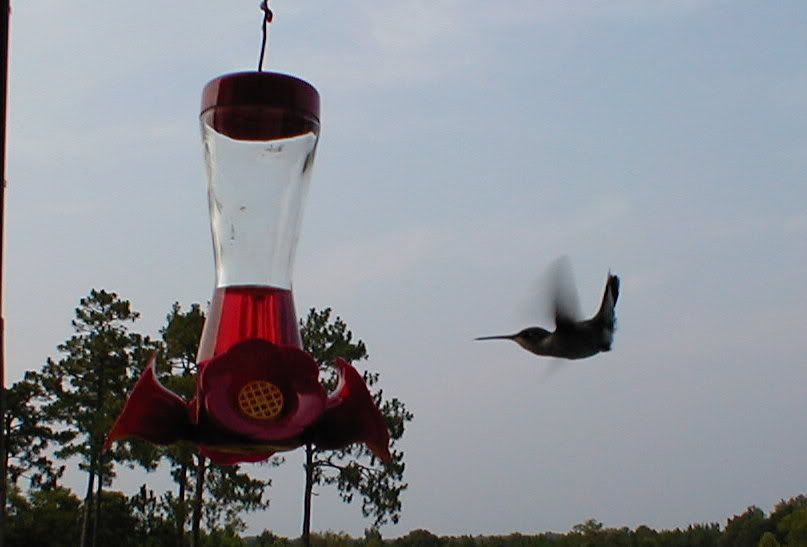
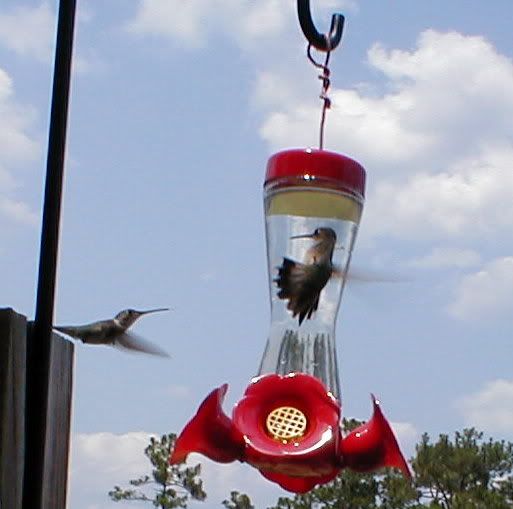
The hummingbird numbers are increasing (slightly). I saw 6, maybe 7 this morning...

Friday, May 18, 2007

Tuesday, May 01, 2007

Bird Watching Fun

Click on the one of the birds below to get started. And then, put your mouse cursor over each of the birds to keep them flying and off of the power lines...


Friday, April 20, 2007

Areo Acrobat


Captured this fellow showing out, both in color and his aerodynamic abilities.
We have only seen three or four individuals this spring. And there may be some reason for that... The Easter Morning cold snap is discussed on the hummingbird.net:


From the email I've been receiving, it's obvious that lots of people are concerned about the April 2007 cold snap and its effects on the Ruby-throated migration. I don't have many specific answers about this unusual event, but I do have a few theories and opinions. The stage was set by an unusually warm early spring, with no significant cold fronts during the entire month of March. As a result, although the arrival of the first migrants on the Gulf coast was normal, some birds made extraordinary speed northward with no bad weather to slow them down. In my opinion, the spring hummingbird migration is constrained by the availability of active insects, not by the blooming of flowers, and there were plenty of bugs for the earliest birds to eat. Freezing temperatures are not a direct factor in hummingbird mortality; healthy Ruby-throated tolerate nights in the teens easily, but freezing weather limits insect activity. Hummers can do without nectar, but they need bugs at least every few days or their nutrition suffers (including their tolerance for cold).

By the first week of April, a few birds had made remarkable progress, particularly into the midwest, which saw unseasonable highs in the 80s. Everyone knew a cold front was long overdue, and it was a nasty one, bringing thunderstorms, hail, sleet, and snow. Hummingbirds do not migrate in flocks.

Each bird has its own internal clock and migration schedule, probably inherited; the migration starts with just a few individuals in early March, builds over several weeks, then tapers off until it's essentially over by June. The dates on the map reflect the earliest birds, not the vast bulk of the population. Since they are spread out both geopraphically and temporally, the species limits its vulnerability to catastrophic conditions, including bad weather. This is also why you may not see any hummingbirds for weeks after the map shows sightings in your area--if a hummer passed through a yard two houses away, you probably wouldn't
notice.

So, a very small percentage of the Ruby-throated population had the misfortune to be caught on the wrong side of the cold front. Will they survive?

There's little research or precedent to suggest answers, but I would expect most individuals to find enough shelter and food to manage, while some others will not. There's an advantage to being first to arrive--a chance to claim the best breeding territories--but there's always a risk of outrunning the food supply. If climate change is moving toward earlier springs, these risk-taking hummers will be in the forefront of an evolutionary shift to earlier migration schedules. But climate deals with averages, over long periods of time, while weather has immediate and dramatic effects. Climate affects populations; weather affects individuals.

What can you do to help? Don't wait to hang your feeders until after you see hummingbirds. Let the map guide your timing. The standard 1:4 feeder syrup won't start to freeze unless nights drop below about 27 degrees Fahrenheit, and even a slushy feeder is better than none at all. You don't need to worry about insects or shelter, because hummers are adept at finding both on their own.

It's heartwrenching to think of hummingbirds dying from the cold, but remember only a small portion of the population is affected, and they're tougher and more resourceful than you might think. I'm more concerned about what's happened to the wildflowers on which the rest of the species will depend as they head north. The loss of flower resources might have a much harsher impact overall than the direct effects of cold weather on the leading edge of the migration. Remember that many hummingbirds never use feeders, so try to replace the freeze-damaged flowers in your garden as soon as you can.


Looks like we need to make a trip to Chas Mar!

Thursday, April 19, 2007

Goslings and Ducklings

It's that time of year again! Sarah and Mama spotted five gosling's following Mother and Father Goose on the pond this afternoon!


And they swam and they swam, all over the dam!

Of course, we had to hold one of the babies. He was light as a feather and downy soft!


We placed him on the ground and Mama "honked" once and he ran as fast as his little goose legs would carry him....


Mother and Children Reunion!
It's like the other four are saying, "Hey, where you been???"


... and, remember the baby ducks from four years ago? shhhhhhhhhhh! Don't tell anyone... There is a Mama Duck that has been on the nest for about 18 days now!!!


Tuesday, March 27, 2007

Hummer Migration facts

From the migration page on hummingbirds.net:

Most Ruby-throated Hummingbirds winter between southern Mexico and northern Panama. Since hummingbirds lead solitary lives and neither live nor migrate in flocks, an individual bird may spend the winter anywhere in this range where the habitat is favorable, but probably returns to the same location each winter. Ruby-throats begin moving north as early as January, and by the end of February they are at the northern coast of Yucatan, gorging on insects and spiders to add a thick layer of fat in preparation for flying to the U.S. Some will skirt the Gulf of Mexico and follow the Texas coast north, while most apparently cross the Gulf, typically leaving at dusk for a nonstop flight of up to 500 miles, which takes 18-22 hours depending on the weather. Although hummingbirds may fly over water in company of mixed flocks of other bird species, they do not "hitchhike" on other birds. Some hummingbirds land on offshore oil rigs or fishing boats to rest. Individual birds may make landfall anywhere between southern Texas and central Florida. Before departing, each bird will have nearly doubled its weight, from about 3.25 grams to over 6 grams; when it reaches the U.S. Gulf coast, it may weigh only 2.5 grams. It's also possible that a few Ruby-throats island-hop across the Caribbean and enter the U.S. through the Florida Keys.

Males depart Yucatan first, followed about 10 days later by the first females. But the migration is spread over a three-month period, which prevents a catastrophic weather event from wiping out the entire species. This means that a few birds will arrive at any location very early (the dots on the migration map), but the bulk of the population will follow later, so you may not see your first hummingbird for several more weeks. Each individual has its own internal map and schedule, and "your" birds may arrive early, late, or anywhere within a two-month span.Once in North America, migration proceeds at an average rate of about 20 miles per day, generally following the earliest blooming of flowers hummingbirds prefer. The northward migration is complete by late May. Banding studies show that each bird tends to return every year to the same place it hatched, even visiting the same feeders.


Well, in that case: Welcome Home, little fellows!

Monday, March 26, 2007

They'rrrrrrrre back......

We had just finished supper. Dishes were loaded into the dishwasher. I was downloading the photos that Sarah had taken today. Sarah walked to the front door and GASPED!!!

"HUMMINGBIRD!!!"

We grabbed the camera and waited... Last summer we finally got hummingbirds to come to our front deck. And they came in groves!

We had been tracking the spring migration on hummingbird.net, so we had set up one of our feeders on the front deck and one in the Paulownina tree on the path to the goat pen. Fresh sugar solution (4:1) was prepared - very similar to Georgia Sweet Tea!

The sun was low in the west and light was fading quickly this evening. But we were able to get several decent shots.


We saw at least 3 of the teeny emerald and ruby buzz bombers - all males today. We can't wait for the chance to take more photos of the hummingbirds in full sunlight!

Thursday, March 01, 2007

Purple Martins

Yay, the Purple Martins are back!
The Purple Martins are back!

Tuesday, July 11, 2006

HummingBirds

Hummingbirds are the newest members of the animal kingdom to be totally spoiled around the house.

Metro, Molly, the Chickens - even the Kois in the small pond by the front deck - are all rotten.

Sunrise is my most favorite time of the day. My routine during the week is to rise as the alarm sounds at 5:45. And with it so ingrained into me (and Metro), it is almost impossible to for me to sleep in on the weekends. So with it still dark outside, I open the front door and let Metro go outside. Business taken care of, the task of coffee is addressed – “extra chewy please”!!!

Back outside the first rays of dawn cause the gray to turn a rosy pink. The first of the thumb sized birds arrive at the feeder. I freeze to make her less nervous as she goes about gathering the 4:1 sugar water mix. Slowly, I make my way to the Adirondack chair in the middle of the deck. Soon the air is full of little buzzing emerald green blurs.

Five, then ten, then fifteen are zipping back and forth and around the house. The red maple over the Koi pond serves as landing pad between drinks. With only four artificial red flowers available to draw the nectar, turf wars begins. Dogfights over the pressure treated yellow pine ensue. Swoops and dives, darts and jives! Midair pirouettes and do-si-dos. The dance of the hummingbirds continues into the heat of the morning. The syrupy solution is soon drained. Too many hummers? Too few feeders!


Solution: More Feeders! So Monday, I make a run to the KRFS to get two more stations! Eight more red plastic flowers with mesh yellow centers are hung around the deck.

Wait a minute, is this the solution? Or, is it the beginning of the snow ball rolling down the mountain?